
This post may contain affiliate links, meaning I make a commission if you purchase through my links, at no extra cost to you. Disclosure here.
My cluttered space used to feel heavy. It seemed like every step I took, I would stumble on something to add to my to-do list. Keeping the house tidy used to be so daunting, especially with two little ones.
This changed when I realised that I can simply let go.

Here are 10 habits for a simplified home and little rules that helped, and it might just help you do the same too.
Keep reading below or watch the video:

1. The 5-7 rule
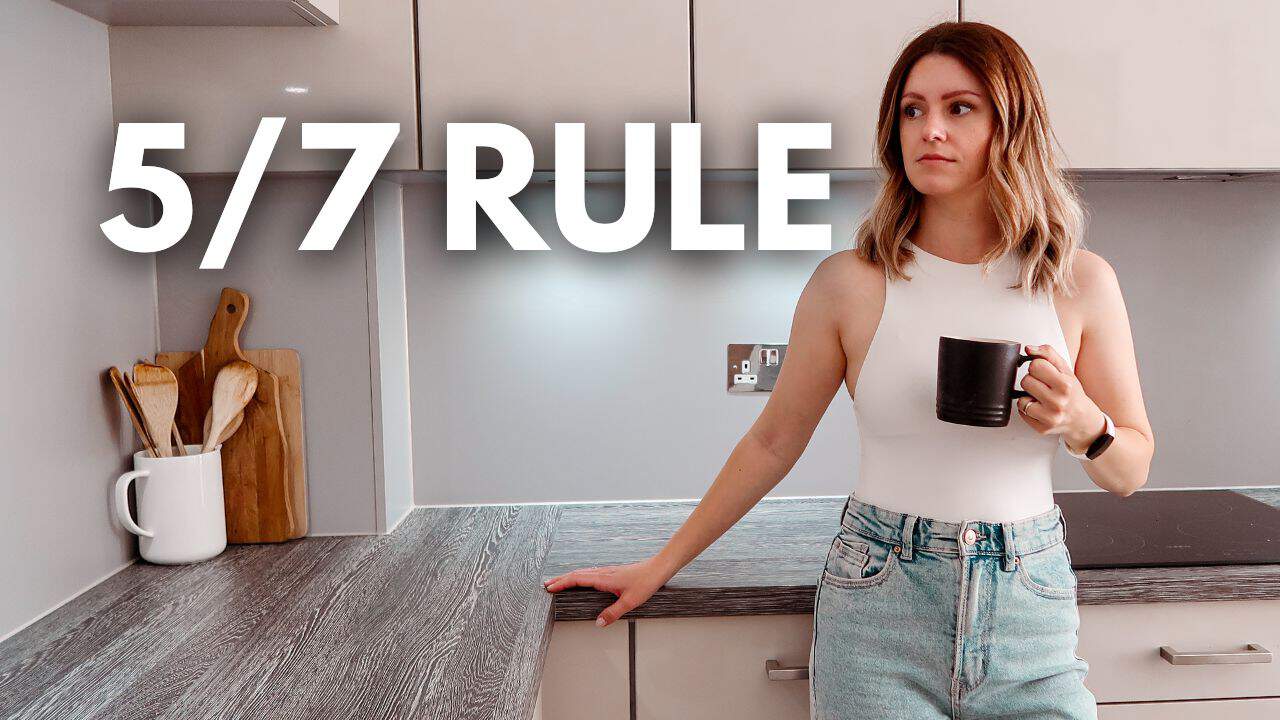
I use this rule to determine what I keep on my kitchen counters. If it’s an item that I use 5 days out of 7, then that warrants a place on my counters.
When I first implemented this rule, the things that passed the test for me were the coffee machine, kettle, and toaster. For anything else, I had to double-check.
Afterwards, I added the spatulas and cutting boards on my counter. They are things that I use almost on a daily basis, and I want to have easy access to them.
Anything else is packed away in my cupboards.
Since I have decluttered my cupboards, I have quite a lot of space in there to keep things, even though my kitchen is not massive. I can keep the bread in a bin in there; it doesn’t need to be out on my counters. My blender mixer appliance can go in the cupboard as well; I don’t need that out all the time.
Clearing out your counters might not seem like a big deal, but it does two things.
Number one: it’s so much easier to clean because the surface is quite clear, so giving it a quick wipe is very easy. You don’t have to move 100 items out of the way before you can give it a wipe at the end of the day or if you spill something.
Number two: it gives me a lot more workspace when I’m cooking, which I really appreciate.
2. The Broken Window Effect
This is a theory in criminology, called “The Broken Window Theory”, and it was coined in 1982. It’s actually a metaphorical theory that says that if there are visible signs of crime, such as a broken window in an abandoned building, that broken window will lead to more broken windows and more antisocial behaviour.
It makes sense, because if you’ve got this neglected environment, if there’s a broken window, and nobody fixes it or addresses it straight away, it gives the impression that no one cares. This will lead to more of that antisocial behaviour that might have caused it and more problems down the road.
What does this have to do with decluttering? Well, keeping a simplified home is very much like this.
Once a surface gets cluttered, if it’s not addressed, if we don’t tidy it up that day, then it’s simply going to attract more clutter onto it. This happens because it gives the impression to everybody in the household that it’s okay, the surface is cluttered anyway, and it doesn’t really matter if we put one extra thing on top of it.
That’s how you end up with piles and piles of stuff that accumulate.
Addressing a surface straight away, trying to keep it tidy as you go along, it’s actually going to help you down the line. This is a good theory that I like to keep in mind because it explains why it’s true what they say: clutter attracts clutter. The more you have, the more likely you are to accumulate more on that surface or in that area of your home.
3. Decluttering consistently
I used to think that if I could just get this big declutter done, then I wouldn’t really have to do it again.
The truth is, decluttering is something that we need to do constantly. And this is not to discourage you or to say that a big decluttering doesn’t work, it absolutely does. But the thing is, we need to go into it with the mindset that yes, we are going to do this big declutter in the beginning, but it is something that needs to become a habit. It’s something that we do consistently in our homes to maintain that clutter-free space.
The truth is, we bring a lot of things into our homes every single week. Kids bring artwork from school, we bring clothes from the shop, and we get boxes from parcels we ordered. There’s always going to be stuff coming in; it’s inevitable. So we need to be mindful about getting some of that stuff out of our house.
The one thing I will say is that decluttering becomes so much easier once you get past that point of ‘Okay, my house is not cluttered anymore, it’s in a good state. Now, all I need to do is little declutters here and there throughout the day to keep it like this.’ Because decluttering is something we do need to incorporate into our routine.
4. Be present in your current season of life
This is something that took me quite a while to grasp. I used to hang on to items that either didn’t fit my lifestyle anymore, I didn’t use anymore, were from past hobbies I wasn’t interested in anymore, or were clothes that no longer fit me. I hung on to them for the longest time because sometimes you want to hang on to that thing from the past.
But in order to move forward with my decluttering process and achieve this calm space and easy-to-tidy home that I really love now, I did have to learn to embrace more of my present life. Embrace who I am right now, and what fits me in my current season as a mom to two young children, and let go of this idea of what future me or this fantasy me might want to wear one day.
5. Keep what you truly need and value
To simplify your home, I’m not saying you need to get rid of the things that you actually enjoy using, that bring value to your life, or that make your life easier. What I’m saying is to find the right balance between what you love and need and what brings convenience to your life.
Sometimes we can go from one end of the spectrum to another and get rid of too much, to the point where it feels like we’re just making our lives harder. But there is a balance that you will find through decluttering. And once you get rid of the items that you don’t really need, you’re more intentional about what truly brings value to your life, what you actually use on a daily basis, and what makes you smile when you walk into a room.
Once you find that baseline of items that you truly want and need, you can get rid of the rest and enjoy a simplified home. It’s not about getting rid of that extra blender if that actually makes your life more convenient and helps your day run smoother. Simplifying your home is about finding what works for you.
6. Simplify your laundry routine
One thing that actually helps with your laundry routine is to declutter your clothes. Having fewer clothes actually makes laundry easier because you’re not going to accumulate piles of clothes everywhere: laundry that needs to be done, laundry that needs to be put away, that needs to be folded, that needs to be dried. Reducing your inventory actually makes this process so much easier.
One thing I’ve incorporated into my laundry routine is doing one load a day, pretty much every day. There are washing machines that you can schedule when to start, so what we do is we set it up to start at about 5:00 a.m. and it ends around 6:00 or 7:00 a.m. This means that by the time we wake up, the laundry is already done. I just need to hang it to dry. Then, towards the end of the day, it’s usually quite dry so I can put it back where it belongs.
Doing this system of laundry every day and doing one load from start to finish means we never have piles of clothes lying around. This is not to brag, my house is not perfect by any means, but this is something that makes it run smoothly..
7. Have a wish list
This is such a simple one, and I’ve shared this before as I love it. I started doing this with my son, who is now 6 years old, whenever he wanted something from the shop but we didn’t necessarily want to buy toys. You know how kids always ask for things, right? It’s what kids do. So we started to keep a wishlist, which a friend of mine recommended.
What we do is we take a picture of the toy that he wants in the shop and we put it in a folder on my phone that’s called his wishlist. And he knows he will leave the shop with that picture on my phone. So even if we don’t buy that toy on that particular day, he still has a bit of that toy that we’re taking with us in the form of that picture.
This really helped curb impulse buying and giving in to every little thing that they want to buy in the shop because that can accumulate so much.
I’m not saying you should never buy toys for your kids, of course not. We still buy toys. This is just about being more intentional and not doing it every single time we go food shopping. And it actually works really well for him.
What ended up happening is that I started using the wishlist system for myself too!
Whenever I want to buy a piece of clothing, whatever it might be, I put it on a wishlist on my phone, either as a photo or an entry on a list in my Notes app. This gives me a cooling-off period so I can see in a few days or a week if I still want that item or if it was just an impulse or emotional buying while I was in the shop. If I really, truly want that item two weeks later, then that’s probably an item I can actually get value out of.
Read more about reducing impulse buys in my underconsumption article.
8. The 2-minute rule
This is such a simple habit and rule that you can follow, and it goes like this: if you have a task in front of you that takes less than 2 minutes to accomplish, do it right then and there. Don’t leave it for later. This actually makes us have less of a mountain of tasks that we need to do because we do them throughout the day.
When I see some rubbish around the living room and I’m on my way to the kitchen, I’ll just quickly grab it and put it in the bin. Or if I see some plates or mugs around, I will take them to the dishwasher when I go that way. If I get a birthday invite, I try my best to reply straight away, put it in my calendar, and be done with it.
These “less than 2 minutes tasks” are things that don’t take long, but the more of these little things we let pile on, the more it feels like this daunting mountain to climb. So doing these little two-minute tasks throughout the day helps a lot.
9. One in, one out
This is one of my favourite rules. Even if it’s not something I necessarily apply for every single item that I buy or comes into my home, it’s something I can incorporate for things like clothes, and sometimes toys.
If an item is in a category that I don’t actually have a lot of space for, I will have to get rid of an old item to put the new one in. This works perfectly for clothes. If I buy a new jacket, can I let go of an old jacket? If I’m buying a new jumper, can I let go of an old jumper I don’t really wear anymore? Because if I’m buying a new one, it’s probably because I have a need that my old item isn’t fulfilling.
Most of the time, I can find things to let go of, and this rule helps me not to have things piling up. If I’m bringing stuff in and also taking stuff out, things balance out. That means my home is not going to get super cluttered again.
10. Check before you buy
If you’re doing a weekly food shop, check your fridge and cupboards beforehand. Just have a quick look in there and see if you need extra pasta, or if you already have enough, for example.
I used to buy packets of pasta, and then I would realise that I already had enough in my cupboard. That’s how we get cupboards overflowing with items that we don’t end up using and end up wasting.
Now, when I do my weekly food shop, I will pick five dinners to make that week, and I will first go through my cupboards and fridge to see if there’s anything I can already use for a meal. Do I have some beans that I can use for a meal next week? Do I have some sausages that I haven’t used this week that I can maybe make into a meal early next week?
This way, I’m using the foods and ingredients that I already have. I’m not piling on in my fridge or my cupboards. It’s way less wasteful, and it’s also better on my budget because I’m going to save a lot of money by using the things that I already have.
These are the 10 habits for a simplified home that I’ve incorporated into my life. Creating a simplified home can be easier than we think. It’s these little habits that help a lot.

I hope this was helpful, let me know your thoughts in the comments below.


Leave a Reply