

This post may contain affiliate links, meaning I make a commission if you purchase through my links, at no extra cost to you. Disclosure here.
Have you ever wondered where your home sits on the minimalism or clutter scale?
After working with a lot of people to help them declutter their homes, and after massively decluttering my own, I’ve learned that these are usually the 7 stages that people go through to get from heavy clutter to calm and clutter-free.

Keep reading below or watch the video:

1. The “It’s normal” stage
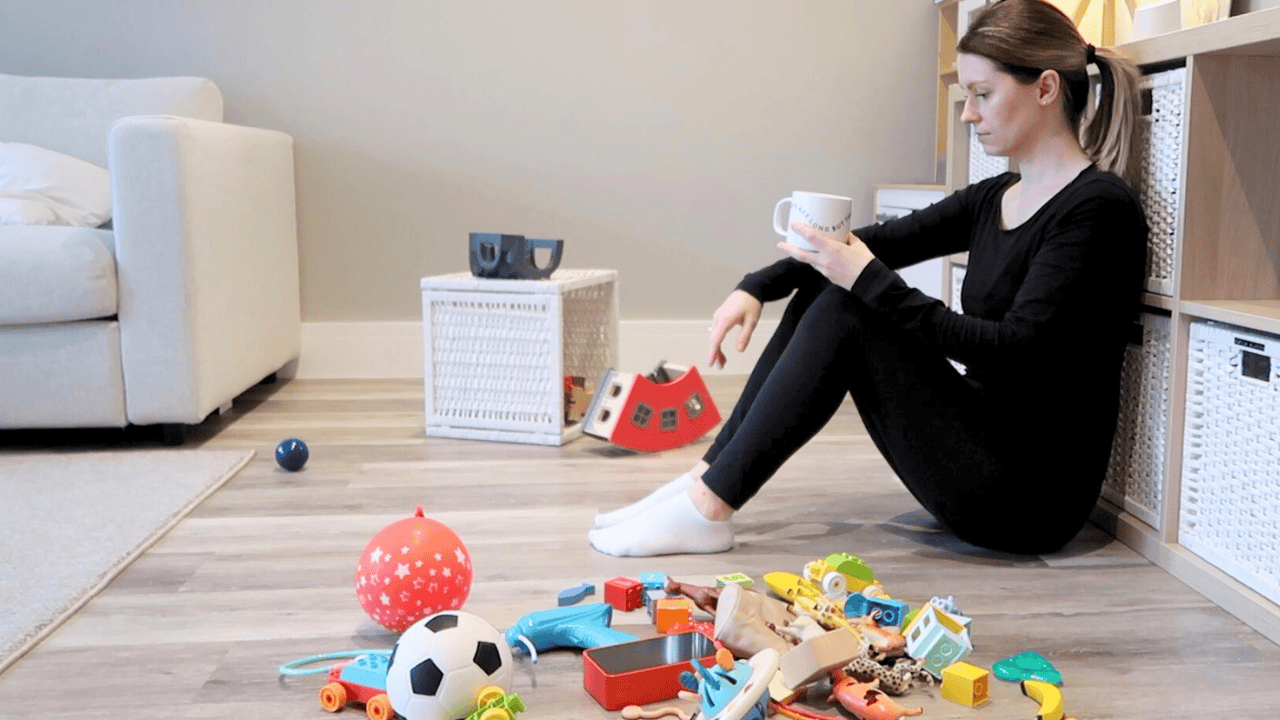
Before realising I had a clutter problem, I used to think, “This is normal.” I used to think that it wasn’t that bad. I’m a mom of two with small children running around and playing. I thought that all the clutter, toys and piles were just part of the deal.
I used to tell myself I didn’t have a clutter issue, and that I didn’t actually buy that much. All the while, I had a wardrobe stuffed to the brim. Yet getting dressed in the morning, I was feeling like I didn’t have enough. I still felt as if I still needed that “perfect piece” to add to my wardrobe, and then everything would make sense.
I had a kitchen but I was never using half of the things in there. And I still remember my kids asking for the watercolour paints. I couldn’t find them for the life of me. I didn’t know where they were. So I repurchased them only to find the initial ones, a few weeks later, in a cupboard behind piles of clutter.
And this is how, slowly, I got to the next stage.
2. The “This is stressful” stage
This is where I got a few years ago when I started my minimalism and decluttering journey, because all the stuff in my home was starting to annoy me.
Stumbling on piles, not being able to find the things needed to wear that day or the items children were asking for, struggling to find shoes for them, having flat surfaces covered with things, and constantly tripping over toys? Maybe these sound familiar. All these little things were starting to get so annoying. They were really making me feel like I wasn’t doing enough and I should just try harder. And like there was something wrong with me since I couldn’t keep on top of my home.
And that’s when I reached the next phase.
3. The “Eye-opener” stage
A few years ago, I was scrolling on Instagram, and I can’t remember exactly whose page I saw this on, but I read about the book Minimalista by Shira Gill. “That’s an interesting book.” I though, expecting it to be more about how to organise a home and keep things looking nice. So I decided to just give it a read, and I asked for it for Christmas from my husband. I then read it in a few days over the Christmas period, and I felt like it opened my eyes.
I also started reading a lot more on the topic, like articles about clutter and how it’s affecting us. It felt like deep down, I knew clutter wasn’t great for us. I had just never realised exactly how much it was impacting me and us as a family.
So I started going deeper into this. I learnt how clutter is affecting multiple areas of our life—like our sleeping habits. Studies have linked it to trouble falling and staying asleep, as well as restless nights. It turns out that just because we go to bed and close our eyes, it doesn’t mean we can fully ignore the clutter around us.
Our bedroom is the first thing we see when we open our eyes in the morning. Then we go into the bathroom to get ready for the day. But if these spaces we wake up to are full of clutter and mess, if it’s hard to find the products we need, all these can trigger the stress response and raise our cortisol levels.
It might also be a struggle to get dressed in the morning. We might feel like we have a wardrobe full of stuff, but still nothing to wear, because we have a lot of those things bought on impulse or trendy pieces that don’t truly fit with our lifestyle.
All of these little things add up. And it really makes us open our eyes and realise, okay, we need to tackle this.
This is how I moved on to…
4. The “Declutter” stage
Decluttering can make a huge difference in our lives and relationships. Studies show that many people who are in a relationship argue on a weekly basis over the clutter in their homes.
Yet decluttering can help so much. It can lead to us being more present, for example. And it can help us spend less time clearing up every evening and have more time to chill with our family or partner.
As I went through these phases, I started decluttering. To be honest, at first I thought, I’ll just dedicate a weekend. Just declutter everything, and that will be it—I’ll see all the benefits. But then I realised I didn’t actually have the time to declutter everything in one weekend.
So instead, I started doing small declutters. Just 10 or 15 minutes here and there, maybe 30 minutes if I had the time. I started with the mug cupboard, going through the 30 or 40 mugs we had—we didn’t need this many, and getting rid of the ones we didn’t truly use.
Then, I slowly went through my kids’ toys. I got rid of all the things they were just throwing on the floor every single day without really playing with.
I also decided to let go of all the items in my wardrobe that I wasn’t wearing, and there were quite a few. Some of them didn’t fit me anymore. And with some of them, I had liked the look of them on the hanger, but I had never liked them on me. Yet they were all in my wardrobe still.
There are so many things like this that we can declutter to make space in our homes, bring more clarity to us, and calm our minds as well.
One other thing we can also do in this stage is to declutter our digital presence. And this is something I haven’t thought about for the longest time.
I remember moving country, about six years ago now, from Romania to the UK, where we are now, and signing up with our personal data on many websites, like for our bills. And in the months that followed, we started receiving so many spam phone calls. It was pretty obvious that our personal data had ended up in a lot of unwanted places.
And this is where decluttering goes beyond just the physical space. Personal data often scatters across the web, cluttering our digital presence too, often without us even realising it. Companies known as data brokers collect and sell this information, and it’s not just email addresses or phone numbers. It can include things like health details, financial info, employment history, and even the number of children in a household.
With data breaches on the rise, clearing out that digital clutter is becoming just as important. And there are many tools out there that make it easier to remove personal data from these sources and protect our privacy.
5. The “Slow benefits” stage
This is where the decluttering starts to show its benefits. There’s noticeable progress—more space, clearer floors, and a visible dining table again. It becomes easier to find things. Everything feels a little more streamlined because having fewer things to manage simply makes daily life smoother.
Cleaning gets easier, too. When stuff doesn’t cover the surfaces, a quick wipe is all it takes. And everyday routines feel lighter and more manageable.
6. The “Is this ever going to end?” stage
This is where many people tend to get stuck. It can feel like a lot has already been cleared out, yet the space still feels crammed. There’s often a sense of, “I’ve gotten rid of everything I possibly could—so what else is there to do?”
What I’ve learned is that sometimes, we simply need to get rid of more stuff for our space. Even if we might have gotten rid of a lot. If there are still too many things compared to the space we have available, then it will still feel crammed.
Everyone’s a bit different here. But what tends to happen is that the “decluttering” muscle is simply being exercised. The more we use it, the more it becomes a habit—and the easier it gets to make those decisions. Over time, we also become more aware of what we actually use and need. Things start to look different.
I also find it really helpful to declutter in layers.
Let’s say that the first time you do a drawer. You might get rid of a few spatulas, but maybe you think, “Oh, everything else I really need to keep.” And that’s absolutely fine. I think it’s really good to take our time with these decisions.
But as you go about your day and you start using things from that drawer, later on you might realise, “Actually, there are a few more things here that I don’t truly need or use.”
So with the second decluttering you do in that drawer, you might be just a little bit more ruthless or a little bit more realistic with yourself, and let go of a few more things. And that’s why decluttering in layers can be so helpful.
Another thing that might need your attention is the visual clutter. Maybe inside the cupboards, everything looks streamlined and organised, but on the surface, there are still a lot of things left out. There may be a lot of decor that you don’t truly loved, and seeing all of it on a daily basis can still make the space feel crammed and cluttered.
Or it might be that things slowly start creeping back in. We constantly bring stuff into our homes—maybe we buy things, or our kids bring things back from school—and we do need to stay on top of it to keep things from piling up again.
What I’ve learnt is that decluttering needs to become a habit, and it does need to happen consistently.
And I don’t want to scare you. This doesn’t mean you’re going to be decluttering all day, every day, for the rest of your life. But the more you do it, the easier it gets. It’s only going to be a few things here and there to declutter, rather than bags and bags of stuff.
7. The “Habits change” stage
I see a many of my Simply Decluttered course members go through this stage as well. They’ve decluttered a lot of their homes, they’re quite happy with where they are at, and they’ve slowly become better shoppers and more mindful of the things they bring into their homes.
And this is what happened to me as well. Seeing all the bags of clothes I was letting go of, all the waste that I had created, all the things I didn’t truly need or like, made me realise that going forward, I really need to be more intentional with the shopping I do.
This is also where we usually start to create a few more systems in our home. Decluttering allows us to do this because it frees up more space. It also brings a bit more clarity about where to best place things—like setting up a simple system in the entryway for keys and shoes—and making small changes that help the home function more smoothly overall.
Because of decluttering, our habits change and we might also start having more money in the bank, which is what I have found too, because we’re no longer buying so many useless things.
And sometimes we end up saving in ways we just didn’t think of before. One of the most important things I’ve found is that I now have more time for the things that matter to me like spending quality time with my family. I have more time to do nice things together, and I also have more energy for it.
I’d love to know—what stage of minimalism are you at right now?

Leave a Reply